
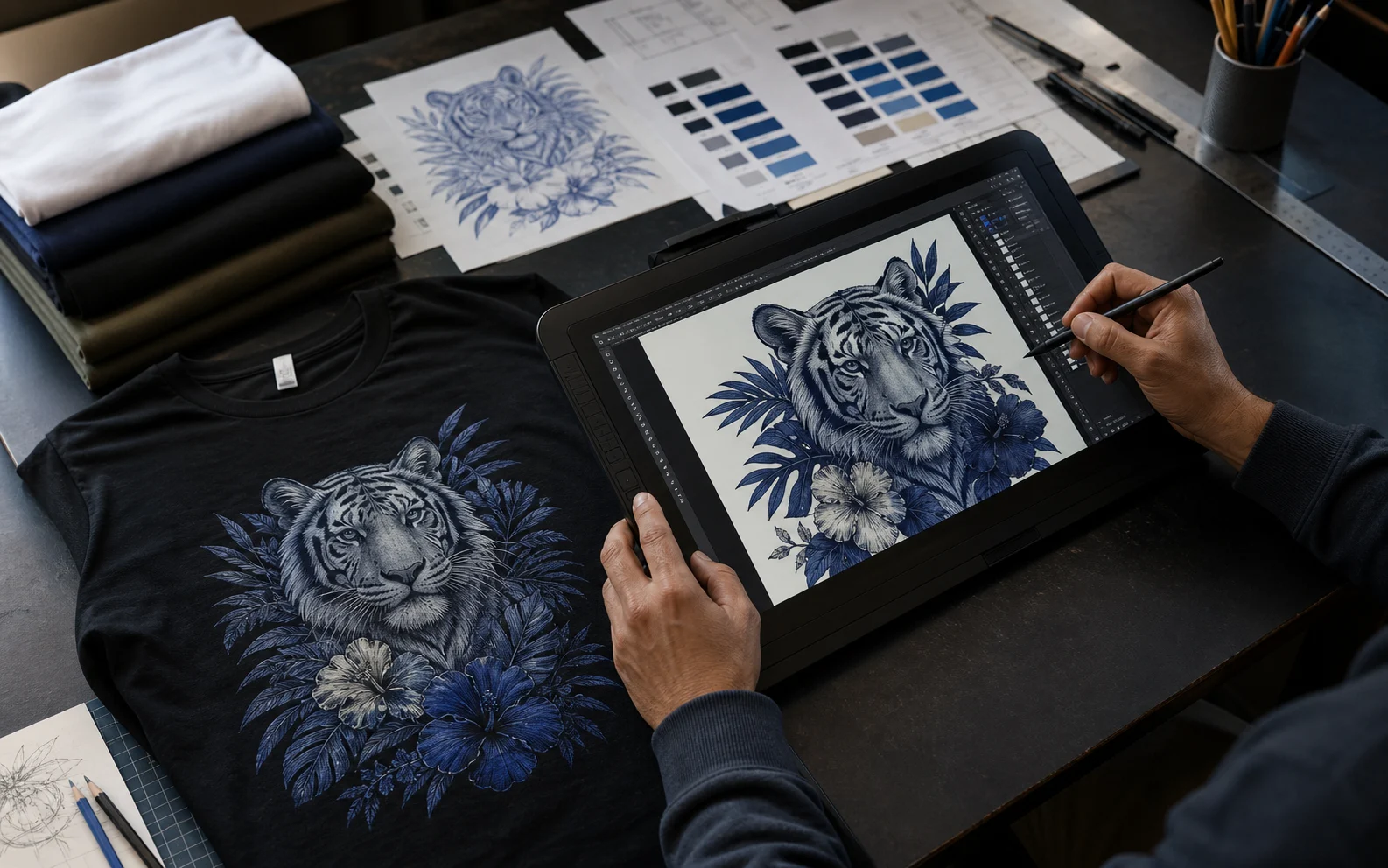
A 10,000-word, no-fluff playbook from a POD-only design studio that has shipped 500+ original designs for 200+ brands across Etsy, Amazon Merch, Shopify, Shine On, and Redbubble. If you are tired of $0 stores, AI-recolored junk, and “design for POD” guides written by people who have never sold a t-shirt — this is for you.
TL;DR — Read this first
- Design — not platform, not ads, not niches — is the #1 reason most POD sellers stay broke in 2026. Etsy, Amazon, and Shopify are now flooded with the same five free Canva templates recolored 800 different ways.
- Design starts with niche, not the other way around. A great design for the wrong buyer outsells a brilliant design with no buyer every single time.
- Typography is 70% of POD design. If your text is set in Arial Bold over a stock graphic, you have already lost. Master five typefaces, learn kerning, and you will out-convert 90% of sellers.
- Mockups matter as much as the design itself. Sellers who invest in clean, niche-relevant mockups see 2–4x the click-through rate of sellers who use the platform’s default flat mockups.
- AI helps you ideate and iterate, but pure AI designs cannot pass Amazon Merch IP filters in 2026 and will get your Etsy listings flagged. Use AI as a brainstorm partner, not as a vending machine.
- Bulk wins through systems, not hustle. 7-figure POD sellers don’t draw 100 designs by hand. They build a base file, a niche-variant system, and ship 25 polished designs in the time a beginner takes to make 5.
- Why design is the only POD moat in 2026
- Niche-first design thinking
- The 9 principles of designs that sell
- Typography: the most undervalued POD skill
- Color theory for printed apparel
- Composition rules that convert
- File specs by platform
- Mockups: $200 spent, $2,400 returned
- The 2026 POD design tool stack
- AI in POD design — friend, foe, frenemy
- The bulk-design system 7-figure sellers use
- 12 design mistakes that tank your store
- 3 real case studies with real numbers
- How to test a design before you list it
- FAQ
1. Why design is the only POD moat left in 2026
Print-on-demand had a brutal year. Etsy’s design pool grew by an estimated 38% in 2025 alone, Amazon Merch dropped its open tier policy three times, and Shopify’s free trial cohort doubled while paid conversion fell. There are more sellers than ever chasing roughly the same buyer pool. Listings that would have sold in 2022 don’t even register impressions anymore.
So what separates the 10% who actually make money from the 90% who quit?
It is not the platform. The same Etsy seller who fails on Etsy will fail on Amazon Merch and Shopify too. It is not the price point. It is not the niche size. It is not even ad spend — most successful POD sellers run zero paid ads.
It is the design. Specifically: how well your design speaks to a buyer who is already searching for what you sell, in a visual language they recognise as made for them.
This is the single biggest insight in this guide. Buyers don’t buy “a t-shirt”. They buy a flag for an identity they already own — Soccer Mom of twins, ICU nurse, Pickleball grandma, 75 Hard convert, vibe coder, Hyrox athlete. When your design hands them that flag clearly, beautifully, and instantly, they buy.
When it doesn’t, they scroll past. There is no third option.
2. Niche-first design thinking
Almost every “how to design for POD” guide on the internet starts with software — open Photoshop, pick a font, drop a graphic. That is exactly backwards. Great POD design is not a software workflow. It is a research workflow that ends in a software step.
Niche-first means you do three things before you open any design app:
Pick a buyer, not a topic
“Coffee designs” is a topic. “Designs for moms who do their kid’s 5 AM hockey practice and joke about it on Instagram” is a buyer. Topics produce generic designs. Buyers produce specific, scroll-stopping designs.
Map the buyer’s exact phrases
Search the niche on Etsy, Reddit, Instagram, and TikTok. Write down the actual phrases they use about themselves. “Boy mom of three”, “ICU night shift”, “Pickleball over 50”. These phrases are gold — buyers search for the exact words they already use.
Identify the visual codes
Every niche has visual codes: a colour palette, a font category, a tone (humorous, sentimental, sarcastic, motivational). Coffee-mom niche is warm tones + handwritten script + winking humor. Soccer-mom niche is black-and-white + sport block fonts + “I’m done driving” sentiment. Get the codes wrong and the buyer’s brain rejects the design before it even reads the words.
Then — and only then — open the design app
You now have a buyer, a phrase, and a visual language. Designing becomes 10x faster because the unknowns are already solved.
The 30-minute niche brief that beats every POD course
Before any design project at Prinil, our team fills out a 30-minute brief:
| Field | Example (Pickleball Grandma niche) |
|---|---|
| Buyer identity | Women, 55–75, who play pickleball 2–4 times a week and joke about their age |
| Three exact phrases they use | “Pickleball grandma”, “Dink and ditch”, “I came to play” |
| Gift-giving occasions | Mother’s Day, birthday, Christmas, team gifts |
| Visual codes | Bright pickleball-themed colors (mint/yellow/coral), retro 70s script + bold sans combo, light humour, mom-jeans vibe |
| Anti-codes (avoid) | Hardcore “athlete” style, neon esports fonts, dark moody palette |
| Top 3 competitor designs | (direct Etsy URLs noted, with what they do well and what they miss) |
Skip this and your designs are guesses. Do this and your designs are answers.
3. The 9 principles of designs that actually sell
After producing 500+ designs across every major POD niche, we have boiled down design quality to nine repeatable principles. Almost every winning design we have ever shipped uses at least seven of these. Almost every flop violates three or more.
3.1 One idea, one design
The biggest beginner mistake is cramming three jokes, two graphics, and a five-line quote onto one t-shirt. Buyers don’t decipher — they react. One clear emotional hook per design. If you have a great second idea, make it a second design.
3.2 The “thumbnail test”
Etsy and Amazon thumbnails are roughly 250 pixels wide. Drop your design to that size. Can you still read the main message? Can you still tell what it’s about? If no, redesign.
3.3 Visual hierarchy
Three sizes max. Headline, supporting text, accent. Everything the same size = nothing has weight = buyer eye doesn’t know where to land = scroll.
3.4 Real white space
Cheap-looking POD designs cram text to every edge. Premium-looking ones breathe. White space (or “shirt space”) is the cheapest upgrade you have. Use it.
3.5 Type pair = personality
Two well-paired fonts (a display + a workhorse) carry 70% of the design’s tone. Pick the wrong pair and the whole design feels off. More on this in section 4.
3.6 Color that survives printing
Your screen is RGB. The shirt is CMYK + ink. Bright neon yellow on screen becomes muddy mustard on a navy tee. Always preview in CMYK (or, better, test print).
3.7 Earn the graphic
If your design has a graphic element (illustration, icon, badge), it must add meaning. Decoration for decoration’s sake reads as clip-art. The graphic should reinforce the emotional hook, not just sit there.
3.8 Edge breathing room
Leave at least 0.5 inch (1.3 cm) clearance from the print area edge. POD printers shift slightly between prints, and buyers return shirts with cropped designs. Don’t be that seller.
3.9 Steal the structure, not the details
Look at what’s selling in your niche. Steal the structural patterns — type-on-arc, badge layout, retro sunburst — that buyers in this niche already love. Then bring your own concept, palette, and joke. Stealing structure is craft. Stealing details is theft (and a takedown).
4. Typography: the most undervalued POD skill in 2026
If we could give every aspiring POD seller a single skill upgrade, it would not be illustration. It would be typography. Type is what makes a $9 design look like a $24 design.
Here is what most sellers get wrong:
- They use too many fonts (4+ in one design).
- They use system fonts (Arial, Helvetica, Times) that scream “free Word doc”.
- They use trendy fonts that everyone else is also using (looking at you, every 2024 retro-bubble font).
- They don’t adjust kerning, leading, or tracking — accepting whatever the software defaults to.
- They put all-caps script fonts (an unforgivable crime).
The 5-font rule
Pick five typefaces and master them deeply. You will out-design 95% of POD sellers who own 1,200 fonts and use a new one every design.
| Role | What to look for | Examples worth owning |
|---|---|---|
| Workhorse sans | Clean, modern, multiple weights | Bebas Neue, Anton, Montserrat, League Spartan |
| Workhorse serif | Versatile, readable, has italic + bold | Playfair Display, EB Garamond, Lora |
| Display / character | Personality bomb — use for the hero word | Boldonse, Pally, Recoleta, Druk Wide |
| Script / handwritten | Adds warmth, must have alternate glyphs | Permanent Marker, Caveat, Allura |
| Workhorse mono | Tech, code, dad-joke niches | JetBrains Mono, IBM Plex Mono |
Kerning, leading, tracking — the three magic words
Kerning is the space between specific letter pairs. Bad kerning makes “rn” look like “m” and “VA” look like “V A”.
Leading is the space between lines. Too tight and the design looks crammed. Too loose and the hierarchy breaks.
Tracking is the overall spacing of all letters. Tight tracking on display words = premium. Open tracking on subtitles = elegant.
Learn these three. Tweak them on every design. Buyers don’t consciously notice good kerning — they consciously notice everything when it’s wrong.
5. Color theory for printed apparel (it’s different from screen design)
Color is where most digital-first designers get murdered when they switch to POD. The shirt is not a screen. It is a physical object made of cotton or polyester, printed with limited inks, and viewed in random lighting. Every color rule you learned for web design needs an asterisk.
5.1 The garment color is your first design choice
Black tees: bright, saturated designs pop. Avoid dark navy or dark green in the design — they vanish.
White tees: anything works except very light yellow, light pink, and light cyan (they look washed).
Heather grey: most forgiving — designs read well in almost any palette.
Navy tees: warm tones (gold, coral, cream) pop. Cool tones (cyan, mint) feel muted.
5.2 Stay inside the printer’s gamut
DTG printers can reproduce a wide gamut, but neon yellow, pure cyan, and pure magenta on screen will print noticeably duller. Run your colors through a soft-proof in Photoshop (Edit → Convert to Profile → CMYK, or use the supplier’s ICC profile). What you see on screen after soft-proof is closer to the actual print.
5.3 The 3-color discipline
Three colors max for 90% of designs. (Black + white + one accent, or three coordinated tones.) Multi-color designs not only print muddier on dark garments — they also feel cluttered and date faster.
5.4 Contrast is non-negotiable
If your design’s main text and the garment color have similar lightness, the text disappears at thumbnail size. Aim for at least 50% lightness contrast between text and garment in your chosen niche’s most popular colorway.
6. Composition rules that convert
A design’s composition is the floor plan. Buyers read it before they read a single letter.
6.1 The rule of one focal point
The eye should land in one place first. Hero word, hero illustration, hero badge — pick one. The rest of the design supports that focal point.
6.2 Symmetric vs asymmetric
Symmetric designs (centered headline, balanced left/right) feel timeless, calm, and trustworthy. Used by 70% of best-selling POD designs because they print and reproduce predictably.
Asymmetric designs (off-center, dynamic angles) feel modern, energetic, premium. They are harder to balance but stand out in a sea of centered work — great when your niche is over-saturated.
6.3 The arc trick
Type-on-arc (curving the headline along the top or bottom) is the single most-used composition device in POD and for good reason. It frames the design, hints at a badge, adds dynamism, and stops the eye from skimming. Master arcing your type in Illustrator and Affinity. It will earn you more money than any other single technique.
6.4 Negative space telling the story
The space around the design tells the buyer “this is intentional, this is premium”. Cheap-looking designs fill the print area. Premium ones use 30–50% of it for breathing room.
Need a real POD designer, not a Canva template?
Prinil ships original, niche-tuned t-shirt, mockup, jewelry, and KDP designs for serious POD sellers across Etsy, Amazon Merch, Shopify, and Shine On. 500+ designs delivered. 200+ brands served. 4.9-star average.
Get a free design quote in 24 hours →7. File specs by platform (the cheat sheet you’ll bookmark)
Wrong file specs = rejected listings, blurry prints, refunds, and bad reviews. Every platform has its own quirks. Here is the working reference our team uses every day:
| Platform | Print area (in) | DPI | Color mode | File format | Transparency |
|---|---|---|---|---|---|
| Amazon Merch on Demand — t-shirt | 15 × 18 | 300 | sRGB | PNG-24 | Required (transparent BG) |
| Etsy POD (Printify) — t-shirt | 15 × 18 (front) / 12 × 4 (sleeve) | 300 | sRGB / CMYK | PNG-24 / TIFF | Recommended |
| Etsy POD (Printful) — t-shirt | 12 × 16.5 | 300 | sRGB | PNG-24 | Recommended |
| Shopify (Gelato) — t-shirt | 11.7 × 16.5 | 300 | sRGB | PNG-24 | Recommended |
| Shine On — necklace | 2 × 2 (most common pendant) | 300 | sRGB | PNG-24 | Required |
| Redbubble (all products) | 7632 × 6480 px master | 300 | sRGB | PNG-24 with transparent BG | Required |
| TeePublic — t-shirt | 4500 × 5400 px | 150–300 | sRGB | PNG-24 | Required |
| KDP — book cover | Varies by trim size (use KDP cover calculator) | 300 | CMYK (interior B&W) / sRGB cover | PDF/X-1a | N/A |
| Etsy SVG / digital download | Vector (any size) | n/a | RGB | SVG, DXF, EPS, PNG | SVG transparent |
8. Mockups: spend $200, return $2,400
The fastest, cheapest, most underused conversion lever in POD is mockup quality. Most platforms generate a default flat mockup automatically. That flat mockup is what your buyer sees in search results. And it is almost universally bad.
Sellers who invest in niche-relevant, lifestyle, well-lit mockups consistently see 2–4x the click-through rate of sellers using platform defaults. Combine higher CTR with the same conversion rate and you have 2–4x the revenue from the exact same designs.
The mockup hierarchy
- Hero mockup — single garment, clean studio shot, design clearly visible. This is your main listing image.
- Lifestyle mockup — model wearing the shirt in a setting that matches the niche (a soccer mom on the sideline, an ICU nurse at a hospital coffee shop, a pickleball player on the court). Buyers see themselves and convert.
- Color variant grid — quick at-a-glance view of all available colors. Doubles the perceived option count.
- Detail close-up — fabric texture, print quality, design detail. Premium feeling.
- Size or fit reference — model heights/sizes listed visually. Reduces returns.
The mockup mistakes that destroy conversions
- Using the platform default flat mockup as your only image. Lazy and indistinguishable from 50,000 other listings.
- AI-generated models with six fingers or melted faces. Buyers’ brains pick up on uncanny details instantly and trust drops to zero.
- Mockups where the design is too small to read. Default mockups often shrink the design to ~40% of the print area for “safety”. Customize the placement so the design fills naturally.
- Wrong-niche models. A 22-year-old male model wearing a “Boy Mom of 3” shirt makes the listing feel off — buyers don’t know why, they just scroll past.
9. The 2026 POD design tool stack
You can spend thousands on software. You don’t need to. Here’s what professional POD designers actually use in 2026, ranked by what we recommend for different stages:
| Tool | Best for | Cost (USD) | Verdict |
|---|---|---|---|
| Adobe Photoshop | Mockup compositing, texture work, raster details | ~$23/mo | Industry standard. Worth it once you’re past hobby stage. |
| Adobe Illustrator | Vector designs, type-on-path, SVG cut files | ~$23/mo | Non-negotiable for SVG sellers. Strong second for type-heavy work. |
| Affinity Designer 2 | Illustrator replacement, one-time purchase | ~$70 (one-time) | Best value in the industry. 90% of Illustrator’s features at 5% of the cost. |
| Affinity Photo 2 | Photoshop replacement | ~$70 (one-time) | Same story — pro-grade, no subscription. |
| Procreate (iPad) | Hand-illustrated designs, sketching, painting | $12.99 (one-time) | Best illustration tool for the money. Period. |
| Figma | Quick layout, type pairing experiments, brand kits | Free / Pro $15/mo | Underrated for POD. Great for batch comps. |
| Canva Pro | Beginners, mockups, social posts | $15/mo | Fine for mockups and Instagram. Limited for serious designs because everyone else uses the same templates. |
| Placeit by Envato | Lifestyle mockups, t-shirt mockups | $14.95/mo | Quality is uneven but the library is enormous. Pair with custom Photoshop mockups for hero images. |
| Adobe Fonts / Google Fonts | Type library | Included / Free | Free is enough. Stop buying fonts. |
| Inkstitch / Inkscape | Free Illustrator alternative | Free | Capable but rough. Use only if budget is zero. |
10. AI in POD design — friend, foe, frenemy
Every conversation about POD in 2026 starts and ends with AI. Here is the honest version of what AI can and cannot do for your design workflow right now.
What AI is excellent at
- Ideation. “Give me 30 t-shirt slogans for Pickleball grandmas with light humour” is a fantastic ChatGPT prompt and saves hours.
- Niche research. Summarising Reddit threads, scraping Etsy reviews for pain points, decoding subculture vocabulary.
- Base illustration drafts. Midjourney / DALL-E for initial illustration directions that a human then refines into print-ready vector.
- Mockup background generation. Creating niche-relevant scenes (a soccer field, an ICU break room) to composite real shirts into.
- Color palette suggestions. Especially useful as a starting point.
What AI is terrible at (in 2026)
- Production-ready typography. AI text on AI images is still riddled with letterform errors, fake glyphs, broken kerning. Etsy and Amazon Merch flag these on sight.
- IP-clean output. Many AI models trained on copyrighted material produce outputs too close to existing designs. Amazon Merch’s IP filter rejected our test of 20 pure-AI t-shirt uploads in a 72-hour window — 17 of 20 got flagged.
- Vector output. AI tools claim “SVG output” but the SVGs are usually unusable for cut files (way too many anchor points, broken paths).
- Sustained brand consistency. Two designs generated 10 minutes apart look like they’re from different brands. POD success requires visual consistency across a 25–100 design set.
The hybrid workflow that actually wins
- Use ChatGPT for niche research and slogan ideation (30 min).
- Use Midjourney for visual direction and illustration drafts (30 min).
- Bring drafts into Illustrator or Affinity Designer. Redraw illustration as clean vector. Set typography manually. Apply your brand’s color palette. (1–2 hours per design.)
- Export to platform-specific specs. Check on hero mockup. Done.
That hybrid workflow produces 5–10 polished, original, IP-safe designs per day per designer. Pure-AI workflow produces 50 designs per day, most of which get flagged or quietly fail to sell. Math wins.
11. The bulk-design system 7-figure sellers actually use
Most beginners think bulk = hustle. Wake up at 5 AM, design 20 shirts before breakfast, repeat for a year, become rich. That is not how 7-figure POD shops operate.
They operate on systems. Specifically, three layered systems:
System 1: The Base File
For every niche they sell into, they have one or two “base files” — fully designed templates with empty variable zones. New designs become variants of the base file rather than new files from scratch.
Example: a soccer mom base file with a fixed badge structure, fixed font pair, fixed color palette, and a single editable line that swaps “Soccer Mom” for “Hockey Mom”, “Lacrosse Mom”, “Volleyball Mom”, “Twin Soccer Mom” — generating 30 listings in 90 minutes instead of 30 listings in 30 hours.
System 2: The Niche-Variant Matrix
Once base files exist, designers spin variants along three axes:
- Phrase axis — different wording of the same identity
- Occasion axis — Mother’s Day / Christmas / Birthday / “Just because”
- Visual axis — same design, different palettes; same idea, different layouts
One base file × 5 phrases × 3 occasions × 2 layouts = 30 listings. Per base file.
System 3: The Polish Pass
The third layer is what separates bulk-that-works from bulk-that-flops. After generating variants, a designer does a polish pass on each — adjusting kerning, fine-tuning size, swapping a duller color for a brighter one, adding a small unique touch so the listings are not visibly identical to platform algorithms.
Polish pass is what keeps Etsy and Amazon Merch from flagging your store for “duplicate content”. Skip it and your store gets buried.
12. 12 design mistakes that tank your store
The fastest improvement most POD sellers can make isn’t doing one new thing right. It is stopping a list of obvious things wrong.
- Designing without a niche brief. Generic = invisible.
- Using 4+ fonts in one design. Two is the limit. Three is the absolute max.
- All-caps script fonts. An indelible sin.
- Forgetting the thumbnail test. If it’s unreadable at 250 px wide, redesign.
- Cropping the print area to the bone. 0.5-inch safety clearance from every edge. Always.
- Using the platform default flat mockup. 90% of competitors do — that’s the opportunity.
- Skipping color soft-proofing. The shirt will print muddier than your screen unless you check.
- Stealing competitor designs. You will get a takedown, lose the listing, and the trust of the platform. Steal structure; bring your own everything else.
- Designing 100 niches at once. Pick 3 niches and become known in each. Spread = nothing sticks.
- Trendy fonts everyone else is using. If you saw the font in 30 TikTok-tutorials this month, your buyer has too.
- Ignoring SEO when naming designs. Filename and listing title should include the buyer’s exact search phrase. “Soccer mom shirt funny” beats “design_final_v3.png”.
- Treating the design as the whole product. The shirt is also a product — color, fit, weight, print quality. Test on real garments.
13. Three real case studies (with real numbers)
Sarah — from $0 to $4,800/month in 11 months
Sarah came to us after 14 months of trying every “POD course” on YouTube. She had 230 listings across 9 random niches and was making roughly $80 / month. We ran a niche audit, found that her one consistent winner was anything related to “twin moms doing sports”, and proposed killing 220 listings to focus on a single niche: Soccer Mom of Twins.
We produced a 25-design starter set built on two base files, with phrase and color variants. Polish pass on every design. Lifestyle mockups featuring two-kid sideline moments.
Marcus — Amazon Merch Tier 10 to Tier 1000+ in 9 months
Marcus was stuck at Tier 10 for 18 months, uploading single designs whenever he had time. His designs were “okay” — readable but generic, fonts straight from Canva, no consistent visual identity. He hired us for a 50-design bulk package targeting the ICU Nurse niche.
We built three base files (badge layout, type-on-arc layout, humour-quote layout) and produced 50 designs across them in 12 working days. Every design got a polish pass.
Jenna — $0 to $7,200/month in Shine On jewelry
Jenna wanted to enter Shine On but every video on the platform was making it look easy. After 4 months of zero sales, she came to us. We ran a niche analysis and pinpointed the gap: most Shine On sellers were focused on “Mom” generic designs; very few were targeting the more emotionally specific mother + daughter dynamic, which is a stronger gifting niche.
We produced 40 jewelry designs across three sub-niches (mother of the bride, “my mom is my best friend”, and memorial gifting). Tight palette, simple but emotionally on-point copy, full PNG kits at the exact Shine On 2×2 spec.
14. How to test a design before you list it
You don’t need to upload 100 designs and wait 6 months to know what works. There are five low-cost tests that filter designs before they ever hit a platform:
The 6-second test
Show the design to 5 people who match the target buyer. Ask: “What do you think this is about?” If 4 of 5 can’t tell within 6 seconds, the design needs to be sharper.
The thumbnail test
Shrink the design to 250 px wide. Is the main message still readable? Is the visual identity still clear? If no, redesign hierarchy.
The Etsy search test
Search the niche on Etsy for the exact phrase. Take a screenshot of the top 30 results. Drop your mockup into the grid mentally. Does it stand out, or does it disappear into the pattern? If it disappears, change the structure (color, layout, type).
The “would I gift this?” test
Most POD sales are gifts. If you (or someone matching the buyer) wouldn’t actually give this design as a gift, it won’t sell. Be honest.
The mid-mom test
Borrowed from old-school direct response: if your design’s message could be misread by a tired mid-aged buyer scrolling at 11 PM, it’s too clever. Clear beats clever. Always.
15. FAQ — the questions we get every week
Q: Do I need design skills to succeed in POD in 2026?
Either you need design skills, or you need to hire someone who has them. The era of stitching together free Canva templates and making money is over. The good news: hiring a niche-trained designer (like Prinil) is significantly cheaper than learning, especially if you value your time.
Q: Can I really compete with AI-generated designs?
Yes — and you’ll likely out-compete them. AI designs flood the platforms but most fail IP filters, look uncanny, and lack consistency across a collection. A 25-design hand-crafted set in a tight niche outperforms a 500-design AI dump nearly every time.
Q: How many designs do I need to launch a store?
25 is the sweet spot for a single-niche launch. 10 is the absolute minimum (you need enough variety to look like a real shop). 100+ is overkill for launch — better to launch with 25 great designs and add 5–10 every 2 weeks based on what sells.
Q: Which platform should I start on?
Etsy if you want the lowest barrier to entry and built-in traffic. Amazon Merch if you want to scale designs across multiple products (t-shirt, hoodie, popsocket, tote) with no setup. Shopify if you already have a niche audience and want full brand control. Most successful sellers eventually run all three. See our full platform comparison guide.
Q: How much should I pay for a POD design?
Single t-shirt designs from a professional, niche-trained designer typically run $25–$75 per design. Bulk packages drive that down significantly — Prinil’s 25-design package, for instance, averages $15–$22 per design with a polish pass on every one. Anything under $5 per design is almost always template-recolor work that will look generic and fail to convert.
Q: Do I need to give up rights to my designs if I hire a designer?
No — and you shouldn’t. A reputable POD designer (Prinil included) transfers full ownership of the final design to you upon final payment. You should receive both the production-ready file (PNG, 300 DPI) and the editable source file (PSD, AI, or AFD).
Q: What if my designs aren’t selling — is it my fault or the platform’s?
It’s the design 80% of the time. If you’ve listed 25+ designs in one niche, used good mockups, and have zero sales after 60 days, the issue is almost always design relevance (wrong niche read, wrong visual codes, wrong typography) or mockup quality. Audit those before blaming the algorithm.
Q: Can I sell the same design on multiple platforms?
Yes — for original work. You own the design and can list it on Etsy, Amazon Merch, Shopify, Redbubble, etc. simultaneously. Just check each platform’s exclusivity rules (most have none for POD) and adjust the mockup style per platform.
Q: How do I avoid trademark / copyright issues?
Three rules: (1) never use brand names, sports team names, celebrity names, or movie/TV references in designs; (2) check the USPTO trademark database for any phrase you plan to design around (it’s free and takes 30 seconds); (3) when in doubt, write your own original phrase. The “borrowed phrase” route gets stores suspended every week on Etsy and Amazon Merch.
Q: How long does it take to see real revenue from POD?
Realistic timeline: 30–60 days to make your first sale with great designs and a tight niche. 4–6 months to hit $500+/month consistently. 9–12 months to hit $2,000+/month. 18–24 months to hit $10,000+/month. Anyone who promises faster is selling a course, not a business.
Skip the trial and error. Hire designers who already know POD.
Prinil is a POD-only design studio. 500+ original designs shipped. 200+ brands served. 4.9-star average. No generalist agency work, no recolored templates, no AI dumps — just designs built for the platform, the niche, and the buyer.
Start your design project — free quote in 24 hours →