
Need more detail before choosing?
Review fit, scope, inputs, review points, responsibilities, and the complete handoff after comparing the package options.
The problem this service solves
A strong drawing can still fail as apparel when its idea disappears at listing size, its type loses hierarchy, or its detail does not suit the selected print method. The real problem is aligning buyer language, garment context, composition, color behavior, and production constraints before polishing the art. Input quality matters: the same phrase can require a different visual answer for a dark heavyweight shirt, a light fashion garment, an oversized back print, or a compact chest placement. References are treated as evidence of tone, density, or production context—not as permission to imitate another seller. When the buyer, required wording, garment color, placement, or production method is unresolved, that uncertainty is recorded before concept work because each choice changes the hierarchy and file preparation.
Good fit / not a fit
Good fit
- You can describe the buyer, niche, occasion, and garment the design is for.
- You want original direction rather than a copy of a competing listing.
- You can confirm the printer or platform file specification before final export.
Not a fit yet
- You need an existing copyrighted character, logo, or competitor design reproduced.
- You need legal clearance, a sales guarantee, or platform approval guaranteed.
- You need a broad editorial illustration without an apparel-specific composition.
Scope and handoff
Deliverables
- A brief summary connecting buyer language to the chosen creative direction.
- Concept route or routes defined in the written scope.
- Review proof at realistic listing and garment scales.
- Final print files prepared to the confirmed size, color, and background specification.
- A concise file and rights handoff identifying included formats and approved uses.
- A production QA note recording the approved wording, dimensions, transparency or background state, color assumptions, and checks completed before export.
- An asset manifest that distinguishes concept proofs, approved master artwork, production exports, mockup-only files, and any separately scoped editable source.
Exclusions
- Niche research unless it is separately scoped.
- Listing copy, uploads, mockup subscriptions, and product configuration.
- Trademark, copyright, or marketplace-policy clearance.
- Unspecified source files, fonts, stock licenses, or unlimited revisions.
- Printer calibration, garment sampling, color matching, or physical-production testing unless the responsible vendor, test conditions, and approval step are written into scope.
How the work is approached
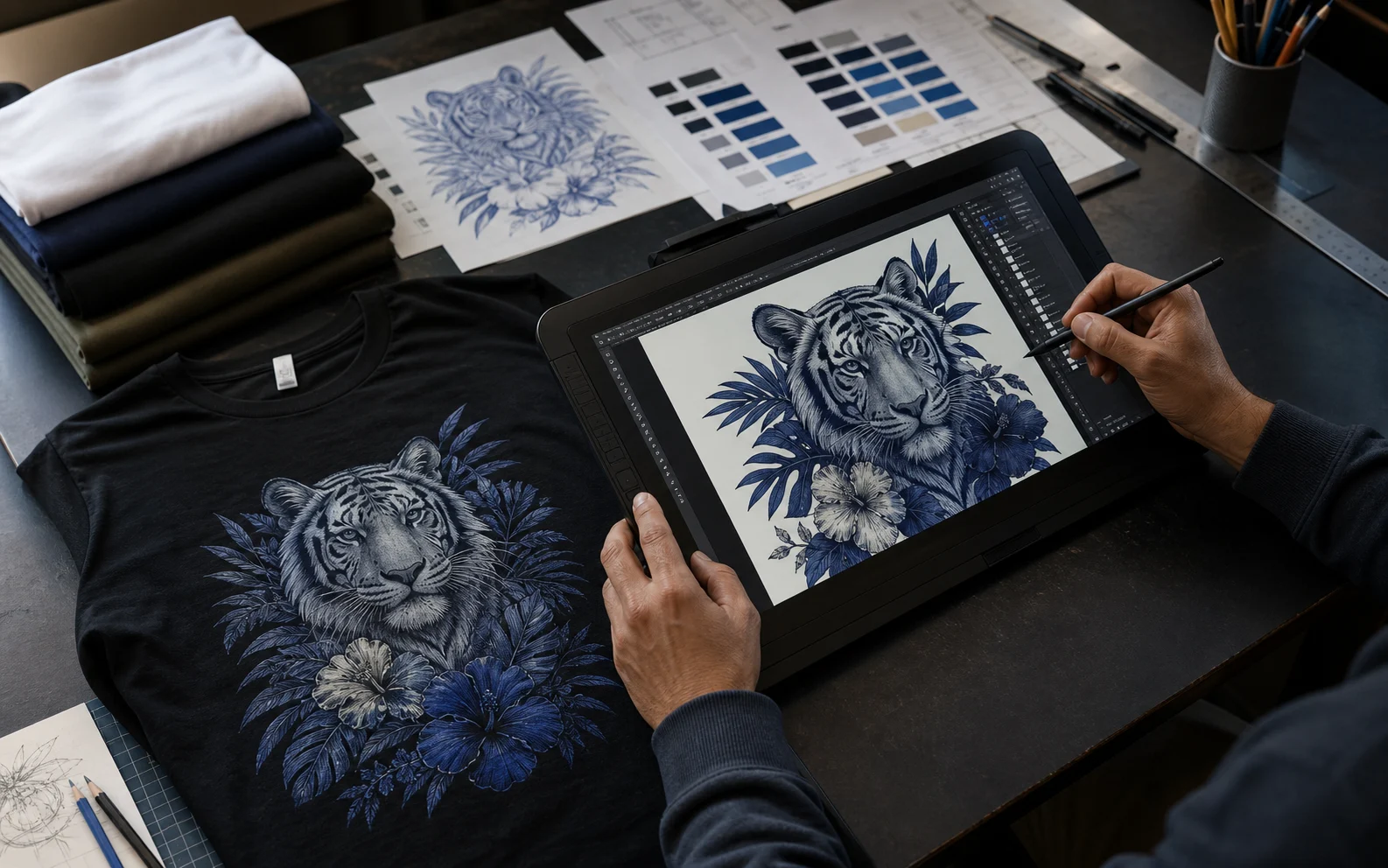
Prinil starts with the phrase or identity the buyer should recognize, checks the concept at thumbnail distance, then builds typographic hierarchy, image weight, negative space, and color for the garment. Detail is reviewed at actual output size before the agreed production files are prepared. The decision sequence is explicit. First, the brief identifies the primary reading, the supporting reading, and what may remain decorative. Next, rough routes are tested as silhouettes on the intended garment colors so an attractive detail cannot disguise a weak overall shape. Typography is checked for spelling, line breaks, punctuation, letterform ambiguity, and the way outlines or distressing behave at the requested scale. Illustration detail is judged against the selected print process rather than an unrestricted screen preview. The approved route is then placed into a production proof that records placement assumptions and separates presentation mockups from files intended for manufacture. QA compares the final export with the approved copy and master art, checks canvas size, edge clearance, transparency, unwanted objects, color mode where relevant, and whether small elements remain intentional at output size. If a requested change alters the buyer, phrase, product, placement, or print method after direction approval, it is escalated as a scope decision instead of being hidden inside refinement.
From intake to handoff
- Define the buyer signal — Confirm the audience, use context, garment, placement, print method, reference boundaries, required copy, and the idea that must read first. The intake also identifies garment colors, production template, variant needs, prohibited elements, source of client-supplied words or marks, and the person authorized to approve direction. Missing specifications are logged as blockers rather than guessed.
- Choose a direction — Review the scoped concept route for hierarchy, originality, buyer relevance, garment behavior, and production risk before refinement. The proof shows a small listing view and a garment-context view, names the choice being approved, and identifies details that will be simplified or strengthened. Feedback is reconciled by the named approver so contradictory comments do not become accidental scope.
- Refine at two scales — Check the work both as a small listing image and at intended print size, then resolve type, spacing, color, negative space, edges, transparency, and printable detail. Wording is compared with the approved copy, and variants are checked against the master rather than edited independently. A production concern is returned with the affected element and decision needed, not silently repaired in a way that changes the design.
- Prepare the handoff — Package only the approved formats, dimensions, background treatment, variants, naming, and rights described in the quote. The handoff identifies the master file, production exports, presentation-only mockups, software or font dependencies, known limitations, and the next owner. It also records anything not tested physically so file delivery cannot be mistaken for printer or marketplace approval.
Rights, access, and security
The proposal defines permitted uses, transfer conditions, editable-file inclusion, exclusivity if any, portfolio-display permission, and any continuing third-party licenses. Client-supplied marks, photographs, wording, translations, and reference assets remain the client’s responsibility to provide with permission. Prinil records whether fonts, stock, or other licensed inputs can travel with the handoff; a flattened production export does not silently transfer an unrelated license or every working file. No store password, payment credential, customer record, or account export is needed for design delivery. Public intake should use links to non-sensitive references only, and any later transfer of working material follows the approved project route.