
Need more detail before choosing?
Review fit, scope, inputs, review points, responsibilities, and the complete handoff after comparing the package options.
The problem this service solves
Asking for a style before defining the communication problem often produces an attractive but unusable image. Illustration needs a clear audience, application, message, hierarchy, reproduction context, and rights scope before the visual language is chosen. Useful inputs explain what the viewer should notice, understand, or feel; where the image appears; what must coexist with it; what sizes, crops, colors, and reproduction methods matter; and who has authority to approve the concept. References should identify qualities such as energy, restraint, texture, viewpoint, or narrative density without requesting another artist’s distinctive expression. When one image must become a family of assets, the reusable rules and variation plan belong in the brief rather than being inferred after the hero image is finished.
Good fit / not a fit
Good fit
- You need an original image for a product, brand, publication, campaign, or asset system.
- You can define where the image appears, what it should communicate, and who approves it.
- You want to review concept routes before final rendering.
Not a fit yet
- You need another artist’s exact style, a copyrighted character, or an unlicensed asset reproduced.
- You need an apparel composition or machine-ready cut file as the primary deliverable.
- You cannot yet define the application, audience, rights, or decision owner.
Scope and handoff
Deliverables
- An application-aware visual brief and art-direction criteria.
- Scoped concept sketches or routes with decision notes.
- Approved illustration refined for the named uses and reproduction constraints.
- Final file formats, sizes, color treatments, and backgrounds listed in the quote.
- A rights and source-file handoff identifying any continuing licenses.
- An application matrix showing each approved placement, crop, aspect ratio, background, color treatment, text-safe requirement, and final export mapped to its use.
- A concept decision sheet that records the visual problem, criteria, routes considered, selected rationale, rejected risks, and questions carried into refinement.
- A final QA contact sheet comparing approved composition, required content, crop behavior, scale, contrast, edges, color assumptions, and named variants before handoff.
Exclusions
- Copying living artists, protected characters, client competitors, or unlicensed reference material.
- Apparel merchandising, SVG cut engineering, animation, or full publication layout unless scoped.
- Unspecified adaptations, aspect ratios, editable files, or unlimited revisions.
- Performance, publication, printing, or platform-acceptance guarantees.
- Brand strategy, copy approval, legal review, accessibility certification, factual validation, or production-vendor responsibility unless those owners and outputs are separately defined.
How the work is approached
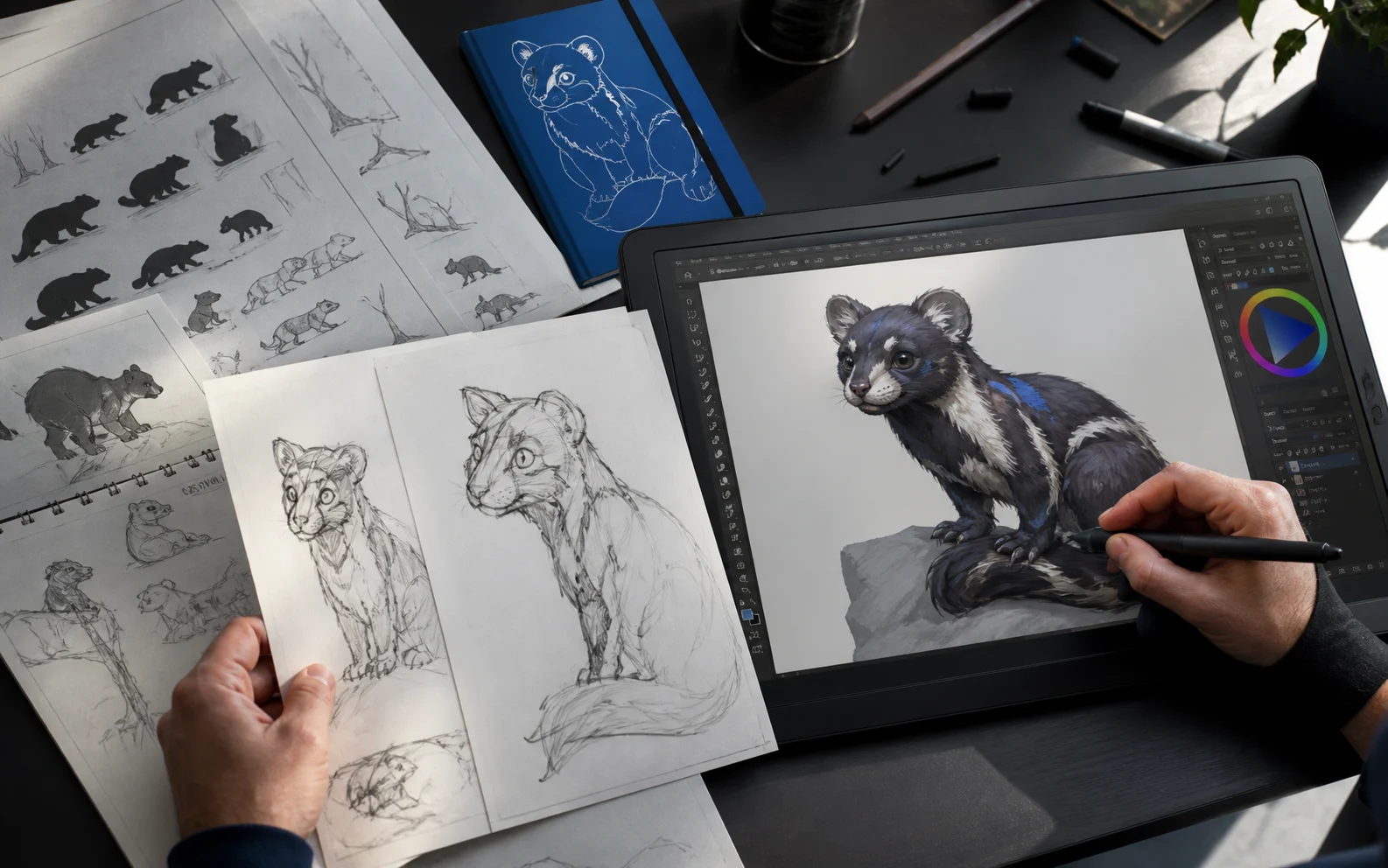
Prinil translates the communication problem into art-direction criteria, explores distinct concept routes, records why a route is rejected or advanced, and refines the approved composition for its actual application. The file plan follows the use case instead of being decided at the end. Criteria may include immediate subject recognition, narrative viewpoint, emotional temperature, relationship between image and copy, silhouette, focal hierarchy, brand compatibility, reproduction limits, and ability to extend into a system. Early routes differ in idea or composition, not just palette, so the review can make a real decision. The decision sheet explains what each route solves and where it creates risk. Refinement then tests the chosen art in the smallest and largest named applications, against light and dark backgrounds where scoped, and with actual text-safe or crop constraints rather than an empty canvas. QA checks required objects, spelling within illustrated lettering, anatomy or spatial continuity appropriate to the brief, unintended tangencies, edge artifacts, transparency, color treatment, export dimensions, and consistency across variants. A request that changes the audience, message, central metaphor, viewpoint, or primary application returns to art direction. It is not treated as a minor rendering correction simply because the same illustrator can execute it.
From intake to handoff
- Define the visual job — Confirm audience, communication task, application list, surrounding copy or interface, dimensions, crops, backgrounds, reproduction limits, reference intent, required and prohibited content, rights, and approval owner. The brief separates facts the image must carry from creative choices the art direction is meant to solve.
- Explore concept routes — Review genuinely different compositions, viewpoints, symbols, or metaphors against the criteria rather than choosing by polish alone. Each route is shown at an appropriate rough level with a decision note. Feedback identifies which criterion is unmet, and the named approver reconciles conflicting stakeholder preferences before one direction advances.
- Refine for use — Develop the approved route and test crop, scale, color, contrast, text-safe space, edge behavior, and detail in the actual applications named in scope. The application matrix prevents one export from being assumed suitable everywhere. New placements or aspect ratios are assessed for composition impact before they become variants.
- Document the asset handoff — Reconcile the final contact sheet with the approved route, then supply the agreed masters, variants, crops, backgrounds, and formats with notes covering use, naming, editable files, color assumptions, linked resources, licenses, tests not performed, and future adaptations. The next owner can see which asset belongs where without treating a presentation proof as production art.
Rights, access, and security
The proposal names approved applications, products or channels, geography or term if relevant, transfer conditions, exclusivity if any, source-file inclusion, portfolio permission, and any third-party license that continues. The client confirms rights to supplied references, photographs, logos, copy, characters, products, and brand assets. A mood reference is not permission to copy protected expression, and delivery of a final image does not imply blanket rights to every sketch, rejected route, font, stock element, or working file. Confidential briefs and assets use the approved project route; no store password, payment credential, customer export, or unrelated account access is needed.