
Need more detail before choosing?
Review fit, scope, inputs, review points, responsibilities, and the complete handoff after comparing the package options.
The problem this service solves
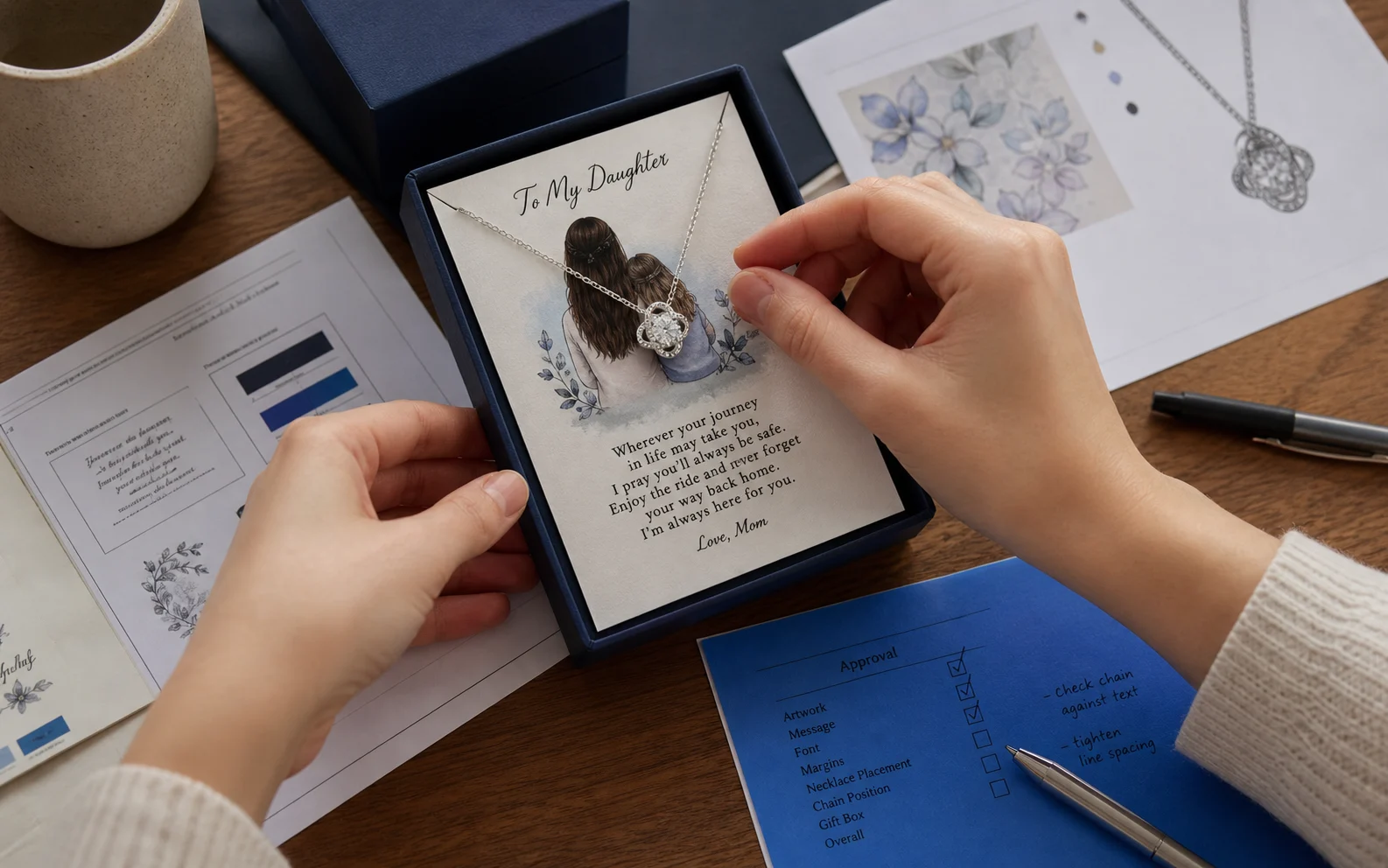
Gift products ask a small card to carry a large emotional idea. When the relationship, occasion, headline, supporting message, and product frame compete at once, the card becomes hard to scan and difficult to adapt consistently across variations. The input problem is often hidden inside copy: the giver and recipient may be clear, but the emotional promise, personalization fields, card template, pendant opening, product image, or approved wording is not. Those facts determine where the eye lands and how much text the small format can carry. A card system must also distinguish stable design rules from fields that change by recipient or occasion, otherwise every variation becomes an uncontrolled redesign.
Good fit / not a fit
Good fit
- You know who gives the gift, who receives it, and the occasion or sentiment.
- You need a designed message system rather than a copied marketplace layout.
- You can confirm the product template and required export dimensions.
Not a fit yet
- You need a platform account, product, or supplier configured as part of design-only scope.
- You want unlicensed quotes, characters, songs, or competitor cards reproduced.
- You require a promise about clicks, conversions, or sales.
Scope and handoff
Deliverables
- A message hierarchy for giver, recipient, occasion, headline, and supporting copy.
- A scoped visual direction with typography, color, framing, and artwork choices.
- Card variation rules for the approved personalization or relationship set.
- Final card files prepared to the confirmed template dimensions.
- A handoff note identifying copy, product, mockup, and configuration boundaries.
- A variation matrix that records the approved recipient, occasion, headline, personalization fields, product template, and file matched to each scoped card.
- A small-format QA proof showing reading order, safe areas, product visibility, and the wording checked before export.
Exclusions
- Product sourcing, jewelry manufacture, fulfillment, or supplier quality control.
- Unscoped copywriting, translations, or open-ended personalization sets.
- ShineOn account setup, product publishing, store configuration, or advertising.
- Performance guarantees or implied platform partnership.
How the work is approached
The card is built from the relationship outward: giver and recipient first, then occasion, central sentiment, supporting line, and product frame. Prinil tests the reading order at the card’s real display size and defines repeatable rules before producing variations. Intake separates fixed content from variables: product template, card dimensions, pendant or presentation opening, required marks, approved sentiment, names, dates, recipient labels, and seller-owned product fields. Early proofs use the longest plausible approved wording so a short sample does not conceal a layout that breaks on later variants. QA checks spelling, line breaks, punctuation, contrast, edge clearance, product obstruction, font behavior, and whether the emotional headline still reads before decorative elements at realistic display size. If a requested recipient or occasion changes the meaning rather than a named field, it returns for copy and hierarchy approval instead of being treated as a mechanical swap.
From intake to handoff
- Map the gift context — Confirm giver, recipient, occasion, product template, sentiment, personalization fields, required product visibility, and wording restrictions. The input sheet marks which copy is final, which fields vary, who approves emotional language, and which supplier template is current.
- Set the emotional hierarchy — Decide what should be read first, what supports it, where the product must remain visible, and how decoration frames rather than competes with the message. A concept proof records the chosen reading order and the variation rule being approved.
- Test the card system — Review at realistic small format, check the longest scoped copy and personalization case, and apply the approved rules to recipient or occasion variants. A broken line, missing name, crowded product opening, or meaning-changing request is flagged with the owner decision needed.
- Deliver to specification — Export the approved cards for the confirmed template, reconcile every file against the variation matrix, and document product, mockup, listing, and configuration fields still owned by the seller. Unperformed physical or platform tests remain stated as limits.
Rights, access, and security
Rights apply only to the approved original design and uses written into the agreement. The client must have permission for supplied names, personal photographs, quotations, song or literary excerpts, fonts, and marks; sentimental context does not remove those obligations. The handoff identifies editable-file status and any continuing font, stock, or template license. Personalization samples should use approved non-sensitive examples rather than unnecessary customer data. Design delivery does not require account credentials, payment access, customer exports, or control of the seller’s ShineOn or storefront account.