
Need more detail before choosing?
Review fit, scope, inputs, review points, responsibilities, and the complete handoff after comparing the package options.
The problem this service solves
Books reveal inconsistency that a single polished image can hide. Character proportions drift, props change, page density loses rhythm, or line work becomes unsuitable for the intended reader and print size. The solution begins with a repeatable system and sequence-level review. Input readiness affects every later page: manuscript version, audience assumption, page count, trim, binding, bleed, color treatment, reading direction, text placement, recurring characters, educational or activity instructions, and printer specification must have owners. A late wording or page-order change can invalidate composition, continuity, and pagination together. The book plan therefore records which content is approved, which production facts are confirmed, and which questions require an editor, publisher, printer, platform, educator, or qualified adviser rather than an illustration decision.
Good fit / not a fit
Good fit
- You have a manuscript, page plan, or approved content outline and a defined audience.
- You want character and page systems reviewed before all final pages are produced.
- You can confirm trim, bleed, color, binding, and file requirements with the intended printer or platform.
Not a fit yet
- You need a publisher, literary editor, ISBN provider, or guaranteed platform approval.
- You need copyrighted characters or another artist’s style copied.
- The manuscript, page count, audience, or production specification is still open-ended.
Scope and handoff
Deliverables
- A visual brief covering audience, tone, trim, page count, and production constraints.
- Character or motif sheets with continuity notes.
- A scoped sample sequence or consecutive spreads for approval.
- Final cover and interior artwork or layouts named in the quote.
- Production exports and a handoff record for the confirmed specification.
- A page map linking manuscript beats, text load, characters, locations, recurring objects, activity type, and approval state to each spread or page.
- A continuity register for proportions, clothing, expressions, props, settings, palette or line rules, and any intentional changes across the sequence.
- A preflight note covering page order, trim, bleed, gutter, margins, color or line treatment, image resolution, naming, and checks performed against the confirmed production specification.
Exclusions
- Writing, developmental editing, proofreading, translation, or sensitivity review unless separately scoped.
- ISBN, barcode, publishing-account, marketing, or distribution services.
- Guarantees of KDP or printer acceptance, educational suitability, or commercial performance.
- Unspecified source files, formats, page changes, or unlimited revision cycles.
- Fact checking, developmental or educational validation, accessibility certification, age-rating decisions, print purchasing, proofs, or distribution unless explicitly assigned to an appropriate owner.
How the work is approached
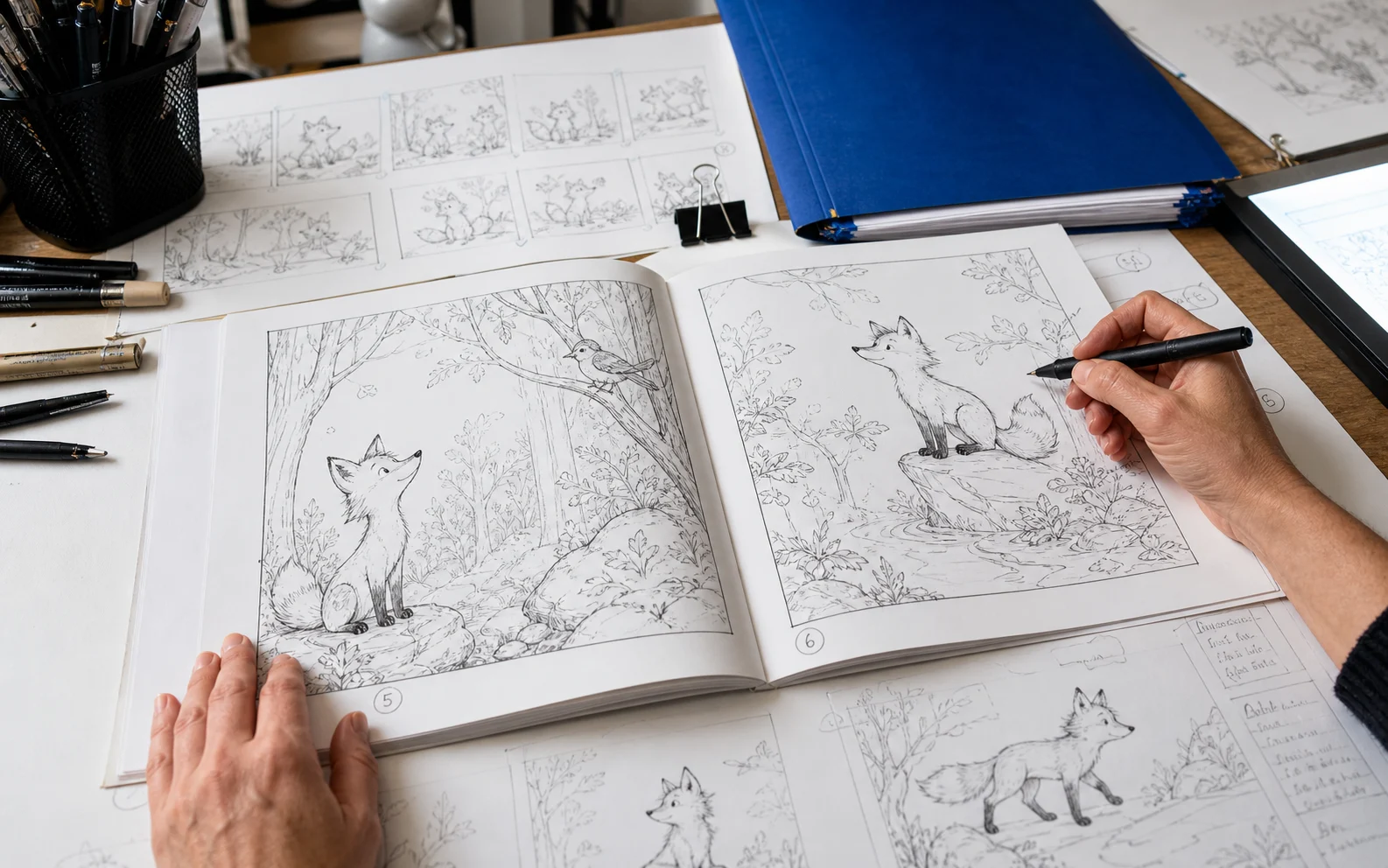
Prinil establishes the visual grammar before producing the sequence: character proportions, expressions, recurring objects, line quality, page density, palette, and print constraints. A character sheet and consecutive pages are reviewed together so continuity decisions happen early. The manuscript or activity plan is converted into a page map that shows text load, visual beat, setting, characters, page-turn function, and production state. Character and motif sheets describe front, side, expression, scale, clothing, prop, and line or color rules only to the depth the sequence requires. A sample run uses consecutive pages rather than isolated favorites, because pacing problems appear when quiet, dense, repeated, and transitional pages meet. For coloring work, QA considers open areas, line separation, trapped shapes, border behavior, age and motor assumptions supplied by the client, and how the page reproduces at the agreed size; it does not claim educational or therapeutic suitability. For story work, review checks character continuity, eye direction, staging, text-safe areas, page-turn information, and whether repeated settings remain legible without becoming mechanically identical. A change log records approved deviations. If a manuscript change affects page count, text load, scene, or character action after a checkpoint, it is escalated with the affected pages and production consequences rather than patched invisibly.
From intake to handoff
- Lock the sequence brief — Confirm the approved manuscript or activity outline, audience assumptions, page and spread plan, trim, bleed, gutter, binding, color mode, line requirements, text owner, production specification, and review owners. The page map marks unresolved copy or publishing questions so visual production does not silently approve them.
- Build the visual system — Develop only the necessary character views, expressions, recurring motifs, prop and setting rules, line or palette logic, and a representative consecutive sample. The review identifies the decisions that must remain stable and any deliberate exception, then records the approved model before full production expands.
- Review in page order — Assess continuity, pacing, page-turn logic, text-safe areas, density, line or color behavior, and production detail across consecutive pages at named checkpoints. QA compares each page with the continuity register and page map. A contradiction is returned with its location, prior rule, proposed resolution, and approver instead of being normalized by guesswork.
- Package the book files — Reconcile page order and filenames, run the scoped preflight, and prepare only the approved cover, interior, source, and export formats for the confirmed production path. The handoff states the master version, included pages, known specification, fonts or linked assets, tests not performed, and who owns upload, proof ordering, platform review, and later corrections.
Rights, access, and security
The agreement states ownership, transfer timing, approved products and channels, source-file inclusion, portfolio permission, exclusivity if any, and any continuing font, stock, or third-party license. The client confirms rights to the manuscript, translations, reference material, names, photographs, characters, and supplied assets, and identifies any contributor whose approval is required. Working pages and manuscripts may be confidential, but public intake should use only non-sensitive references; the project route defines access and retention where needed. Publishing-account credentials, payment access, ISBN accounts, tax records, or customer data are not required for design delivery.