
16 min read
If you talk to enough Tier 4,000 or Tier 10,000 Amazon Merch on Demand sellers, you start hearing the exact same horror story. It almost never starts with someone deliberately ripping off a major movie studio or sneaking a famous athletic swoosh onto a pullover hoodie. Everyone in this business knows that gets you torched before your listing even finishes processing.
Instead, the policy warning email from Amazon lands on a random Tuesday morning at 4:15 AM because of a harmless-sounding three-word slogan in a quiet sub-niche like pickleball, TIG welding, or pediatric nursing. The seller checked the main slogan on a free browser extension six months ago, saw a green checkmark, and pushed the design across eight apparel products and four international marketplaces. What they missed was a newly filed USPTO application tucked inside their second bullet point—or a two-word combination buried inside a five-word graphic that triggered an automated catalog sweep.
When you manage 50 slots in Tier 100, you can eyeball your uploads over morning coffee. When you manage 3,000 to 20,000 live ASINs and a team of virtual assistants pushing 40 listings a day, "eyeballing it" is a ticking time bomb. One careless VA pasting an unvetted synonym into Bullet #2 can put years of compounding catalog equity on the chopping block.
At Prinil, we audit and prepare thousands of listings for sellers who cannot afford account strikes. Below is the exact, non-negotiable trademark clearance protocol we use inside our studio before a single PNG or bullet point ever touches an upload queue.
Why Amazon's Automated Bot Enforces Stricter Rules Than a Courtroom
The Golden Rule of Merch Compliance: Before touching a search database, you need to understand a fundamental truth about Amazon Merch on Demand: Amazon is not a federal court, and their review bot does not care about legal nuance.
In the real world, trademark law revolves around "likelihood of confusion" and whether a phrase on the front of a t-shirt is used as an ornamental decoration versus a brand source indicator on a neck tag. In a courtroom, an experienced intellectual property attorney might successfully argue that printing a common conversational phrase in 48-point distressed type across the chest of a shirt is purely ornamental—often referred to as the Lululemon or Lettuce Turnip the Beet ornamental doctrine.
Amazon's compliance engine does not care. Because Amazon acts as the manufacturer, fulfillment provider, and seller of record on Merch on Demand, their institutional risk tolerance is near zero. If a word string in your Title, Brand Name, Bullet 1, Bullet 2, or image OCR (Optical Character Recognition) matches a live registration—or even a pending application—in the relevant classes, the bot flags it first and asks questions never.
The Retroactive Sweep Problem
Worse yet, Amazon conducts continuous retroactive sweeps across your entire live catalog. A phrase that sails through automated review in October 2026 can get yanked in April 2027 the exact day a pending USPTO application matures into a live registration—or the day a newly registered mark is ingested into Amazon's internal dictionary.
When a retroactive sweep hits an unprotected account, it rarely hits a single t-shirt. If you uploaded that design onto Standard Tees, Premium Tees, V-Necks, Tank Tops, Sweatshirts, Pullover Hoodies, Zip Hoodies, and PopSockets across the US, UK, and German marketplaces, a single overlooked phrase can generate 24 simultaneous rejection notices in a twenty-minute window. That is why checking only "Live/Registered" marks is half a workflow.
Understanding International Class 025 (And the Adjacent Classes That Trap Sellers)
The United States Patent and Trademark Office (USPTO) categorizes goods and services under the Nice Classification system into 45 distinct classes (34 for goods and 11 for services). For apparel sellers, one class rules them all—but four adjacent classes regularly ambush sellers who enable non-apparel products or cross-list onto Etsy and Shopify.
| USPTO Class | What It Covers in Plain English | Merch & POD Product Impact | Risk Level for POD |
|---|---|---|---|
| Class 025 | Clothing, footwear, and headwear (t-shirts, hoodies, sweatshirts, tank tops, raglans, hats, socks, aprons). | All wearable apparel on Amazon Merch, Etsy, and Shopify. | CRITICAL — Mandatory check on every word, sub-string, and phrase. |
| Class 009 | Downloadable software, mobile accessories, phone cases, grips, stands, and protective covers. | PopSockets, iPhone cases, Samsung Galaxy cases. | HIGH — Many gaming and tech phrases clear in 025 are locked down in 009. |
| Class 018 | Leather and imitation leather goods, tote bags, carry-all bags, drawstring backpacks, luggage, pet collars. | Merch Tote Bags and accessory bags. | MODERATE-HIGH — Essential if auto-publishing to bag blanks. |
| Class 020 / 024 | Pillows, decorative cushions (020); Household textiles, throw blankets, bed covers (024). | Merch Throw Pillows and Printify home decor items. | MODERATE — Check whenever enabling home decor SKUs. |
| Class 016 / 021 | Paper goods, stickers, notebooks, coloring books (016); Mugs, tumblers, insulated drinkware, water bottles (021). | KDP books, Etsy stickers, and Printify/Shopify drinkware. | HIGH FOR MULTI-CHANNEL — Never port Merch text to mugs or KDP blindly. |
Here is where experienced sellers get burned: they check a slogan specifically filtered to Class 025, see it is completely clean, and then check the boxes for PopSockets, Phone Cases, and Tote Bags inside their Merch uploader. Two days later, the PopSocket triggers a rejection because a mobile gaming studio owns that exact phrase in Class 009. If you sell across product types, you must clear the classes that match the physical blanks you check—or restrict questionable phrases strictly to wearable garments.
Decoding USPTO Status Codes: Live, Pending, 1A, 1B, and Dead Marks
When your researcher or VA opens a trademark record inside the official USPTO database, looking only at the word "LIVE" or "DEAD" is not enough. Understanding what is actually happening inside the prosecution history of a mark saves you from both false positives (skipping profitable niches that are actually safe) and false negatives (walking into an active legal trap).
| USPTO Status / Filing Basis | What It Actually Means | How Amazon's Bot Treats It | Studio Action Rule |
|---|---|---|---|
| LIVE — Registered (Principal Register) | The mark has passed examination, survived the opposition window, and is an active federal trademark. | Immediate Automatic Rejection if matched in the relevant product class. | HARD STOP. Do not use the phrase or any confusingly similar phonetic variant. |
| LIVE — Registered (Supplemental Register) | Descriptive marks that haven't yet acquired distinctiveness, placed on the secondary register. | High Rejection Risk. Amazon's automated filter rarely distinguishes Principal vs. Supplemental registers. | HARD STOP. Treat Supplemental Register marks in Class 025 with the same caution as Principal marks. |
| LIVE — Pending (1A Use in Commerce) | The applicant claims they are already selling products with this phrase and submitted a specimen. | High Risk. Often ingested into protection filters early or triggers retroactive takedowns upon registration. | AVOID. Even if not registered today, it can turn into a strike within 6–9 months. |
| LIVE — Pending (1B Intent to Use) | A speculative filing where the applicant has not proven commercial sales yet. Frequently abused by POD trademark trolls. | Delayed Time Bomb. May pass upload today, then nuke 15 listings when the Statement of Use clears. | AVOID. Fighting over a pending 1B mark is negative ROI when millions of clean phrases exist. |
| LIVE — Office Action Issued (Non-Final / Final) | A USPTO examining attorney refused the application (often for being "merely ornamental" on a t-shirt). | Uncertain / Grey Zone. Still technically "Live" in raw database feeds until formally abandoned. | WAIT. Do not touch until the six-month response window expires and the status officially flips to DEAD. |
| DEAD — Abandoned / Cancelled / Expired | The application failed examination, the owner missed renewal deadlines (Section 8), or it was cancelled. | Generally Ignored by Automated Filters—unless tied to famous copyright/brand IP. | VERIFY ORIGINAL OWNER. If a random POD LLC abandoned a joke phrase in 2021, it is usable. If a major entertainment studio let a registration lapse, still avoid it. |

The 4-Gate Pre-Upload Clearance Workflow
Stop relying on a single green checkmark inside a free browser plugin. Free plugins cache old USPTO data—sometimes trailing the live federal database by weeks—and they rarely parse partial word overlaps or punctuation tricks accurately. When we train research and listing VAs for our Merch on Demand VA clients, they are required to run every concept through four distinct gates.
Gate 1: Deconstruct the Phrase Into "Sub-Strings" (The N-Gram Method)
If your shirt design reads "Fluent in Sarcasm and Iced Coffee", typing that full six-word sentence into a search bar and seeing "0 Results" means nothing. If someone owns "Fluent in Sarcasm" in Class 025, your six-word variation is dead on arrival because it wholly incorporates the protected mark.
You must break every slogan, title, and bullet sentence down into overlapping two-word and three-word chunks (n-grams) before searching:
- Full String:
Fluent in Sarcasm and Iced Coffee - 3-Word Sub-Strings:
Fluent in Sarcasm|Sarcasm and Iced|and Iced Coffee - 2-Word Sub-Strings:
Fluent Sarcasm|Sarcasm Coffee|Iced Coffee - Modifier + Noun Pairs:
Sarcasm Shirt|Coffee Lover|Sarcastic Mom
Gate 2: Query the Official USPTO Cloud Trademark Search System
Since the USPTO retired the legacy TESS interface and moved to the modern cloud-based USPTO Trademark Search system (tmsearch.uspto.gov), running boolean and field-tagged queries is faster and far more reliable than third-party wrappers. While tools like Productor or Merch Informer are fine for an initial sniff test when learning how to score POD niches, final listing clearance must happen against official USPTO data.
Practical USPTO Cloud Search Syntax for POD Operators: Copy and adapt these exact query structures inside the USPTO Trademark Search bar (with Expert/Field syntax enabled):
- Exact Phrase + Live Status + Class 025:
CM:/.*fluent in sarcasm.*/ AND IC:(025) AND LD:true- Multi-Class Check (Apparel + PopSockets + Totes + Mugs):
CM:/.*your phrase here.*/ AND IC:(009 018 021 025) AND LD:true- Broad Word Overlap (Catching Non-Adjacent Word Combos):
WD:(fluent AND sarcasm) AND IC:(025) AND LD:true- Strip Punctuation & Check Plurals: The USPTO treats "Dog Mom", "Dog-Mom", and "Dogs Mom" as phonetically and commercially identical (pseudo-marks). Always strip apostrophes, hyphens, and plural endings when running your queries.
Gate 3: The "Famous Mark" & Cultural Cross-Contamination Check
Some words and visual structures do not need a Class 025 registration to get your account terminated. Famous marks enjoy broad cross-class protection under federal dilution laws, and institutional properties are heavily policed through Amazon's internal IP enforcement agreements.
- Pop Culture & Implicit References: Even if a line of dialogue from a hit streaming series, anime, video game, or box-office movie isn't registered in Class 025 yet, combining a recognizable quote with character silhouettes or signature color palettes is an immediate copyright or unfair competition strike.
- Institutional, Civic & International Protections: Avoid military branch insignia (USMC, Navy SEALs, Space Force), federal agency acronyms (FBI, NASA without strict compliance guidelines), university nicknames, Boy Scouts/Girl Scouts terminology, and the Red Cross emblem (which is protected by federal statute and the Geneva Conventions—even a red plus sign on a nurse humor shirt can trigger a takedown!).
- Brand-Adjacent Parodies: Swapping two letters in a global coffee chain, fast-food restaurant, or athletic brand's trade dress (e.g., placing a mermaid coffee logo or curved athletic checkmark around a joke) is not a safe parody on Amazon Merch. Automated optical filters flag visual and structural trade dress similarity just as aggressively as text matches.
Gate 4: The Complete Metadata Scrub (Every Single Field Counts)
Here is a mistake that accounts for roughly 60% of the rejections we uncover when auditing new clients' accounts: the graphic on the shirt is 100% clean, the Title is 100% clean, and Bullet #2 contains a trademarked phrase buried inside a casual sentence of gift ideas.
For example, a VA writes a completely original camping shirt listing, and at the end of the second bullet adds: "Makes a great outdoor gift for happy campers who love life is good by the campfire." That accidental inclusion of two famous apparel marks ("Happy Camper" and "Life Is Good") inside a descriptive sentence triggers the exact same automated rejection as slapping them across the front of the shirt in 72-point type.
Prinil's Banned-Word Log: 10 Years of Rejection Lessons for Your Next Upload
A useful upload checklist should remember what your team has already learned the hard way. Over the past 10 years, 10+ members of the Prinil team have collected words and phrases associated with their own rejected uploads in a shared working log. Each contribution gives the next researcher, copywriter, or uploader something specific to check before another listing is submitted.
The current Banned Word column contains 480 recorded entries, including repeated historical entries, in our October 14, 2026 snapshot. This is accumulated operating experience from people who have prepared listings, encountered rejection messages, reviewed their wording, and kept those lessons available to the rest of the team. Its practical value is turning an individual rejection into a reusable checkpoint across future batches.
Why a Rejection Watchlist Belongs Beside Your Trademark Check
A current trademark search helps you review rights and relevant goods. A rejection watchlist preserves wording problems encountered during actual uploads, including product claims, brand references, and phrases that needed closer review in a particular listing context. Using both gives a VA a more complete pre-upload review than relying on a familiar slogan or a single search result.
A clean graphic can still be paired with risky copy. The overlooked wording may sit in the Brand Name, a gift-recipient sentence, or the last few words of a feature bullet. Checking the whole listing against a shared log helps the uploader notice previously reported issues while there is still time to rewrite the draft. That can reduce avoidable repeat submissions, rework, and rejection exposure across a large queue.
Our team calls this its banned-word list, but readers should use it as a reported rejection-risk watchlist. A historical entry does not establish that a word is currently prohibited in every marketplace, product, or sentence. Review the complete phrase, the surrounding copy, the product, current platform policy, and relevant trademark records when a match appears. An unflagged listing still needs the four-gate checks described above.
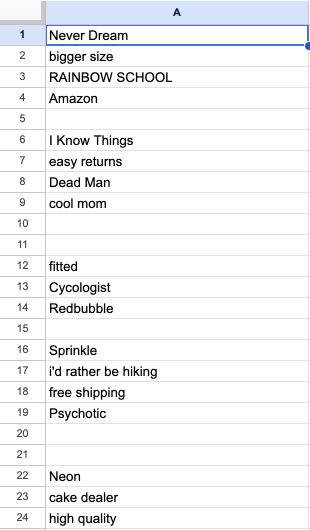
A screenshot from the working Banned Word tab
This cropped preview shows only the banned-word column. Examples visible in the screenshot include free shipping and high quality, which prompt a review of fulfillment and quality claims, alongside brand references such as Amazon and Redbubble. The log also contains ordinary-looking words and phrases recorded from specific rejection experiences.
The screenshot is a sample of the resource. We share the complete, updated Sheet by email with people who agree to contribute words or phrases from their own rejected uploads.
See how to contribute and receive the updated SheetUse the List in Productor Before You Submit
Productor for Merch by Amazon includes warning-keyword checks before submission. Its Banned Words settings let you maintain a warning list for each supported listing language. In the current version checked for this guide, a matching term gives the affected field a red border and a “Banned Word detected” message. This makes a remembered rejection lesson visible where the uploader is entering the listing.
After receiving the updated Sheet through the contribution process below:
- Take the entries from the Banned Word tab. Select its word-and-phrase column. Keep multi-word phrases together, and leave out blank rows. The workbook's advertising negative-keyword tabs serve a different task; use the banned-word entries for this upload check.
- Open Productor's settings and find Banned Words. Choose the language field that matches the listing you are preparing. For English metadata, use the EN field. Menu placement can change between extension versions.
- Add one word or complete phrase per line. Merge the received entries with the warning terms you already use. Preserve the spelling and phrase wording so the historical entries remain recognizable to your team.
- Save and verify the setup on an unpublished draft. Refresh the Merch create or edit screen. Temporarily enter a known term from the list in a draft metadata field and confirm the red warning appears, then remove the test wording. If the warning does not appear, check the saved language list and extension behavior before relying on it for a batch.
- Review every flagged field before uploading. Read the full sentence, check the design text and the other listing fields, and rewrite questionable copy. A red warning is a review checkpoint; it should not be dismissed simply because the same wording appears on someone else's live product.
Productor supports this workflow by drawing attention to a match. The uploader still owns the decision to review the phrase, verify current policy and rights, and submit the approved listing. Keep the list date in your batch record so older drafts can be checked against the latest version before they move into the upload queue.
Contribute Your Rejected Words and Receive the Updated Sheet
Have you encountered a rejection caused by wording that other uploaders should review? Email Prinil at [email protected] with the subject “Banned-Word List Contribution.” Tell us that you agree to contribute words or phrases from your personal rejection experience. In return, we will share the updated Sheet URL with you by email.
Include the details you have:
- The exact word or complete phrase associated with the rejection.
- The marketplace and product type, plus whether it appeared in the artwork, Brand Name, Title, or a feature bullet.
- An anonymized excerpt of the rejection reason and the approximate date, if available.
- Whether the term was explicitly identified in the message or was a suspected trigger after you reviewed the listing.
Keeping that distinction helps the log remain useful: a reported experience should carry enough context for the next person to investigate it. Your contribution can help another uploader catch an avoidable issue, and the updated shared resource gives you the benefit of the team's accumulated lessons.
Share your personal rejection experience and receive the updated Sheet URL by email.
Use this log in the same handoff as your metadata QA checklist and original-concept safety review. The researcher checks the concept, the writer checks the complete copy, and the uploader checks the final fields against the current list before submitting.
Multi-Marketplace Traps: Checking UK (UKIPO), Germany (DPMA), and EU (EUIPO)
If you have auto-upload or international translation enabled for Amazon.co.uk, Amazon.de, Amazon.fr, Amazon.it, Amazon.es, or Amazon.co.jp, a USPTO clearance check only protects your .com listing.
Intellectual property is territorial. A phrase that is 100% generic and un-trademarked in the United States can be a registered Class 025 trademark in the United Kingdom or the European Union.
- The UK & EU "Common Word" Trap: Both the UKIPO (United Kingdom Intellectual Property Office) and EUIPO (European Union Intellectual Property Office) historically allowed registrations on short English slang phrases and single words that the USPTO would have rejected as merely ornamental. Before pushing US bestsellers to
.co.ukor.de, search TMview (tmdn.org)—which aggregates EUIPO, UKIPO, and DPMA data in a single interface—filtered to Nice Class 25. - Automated Translation Collisions: When Amazon's auto-translate converts an English bullet point into German for
Amazon.de, a harmless English idiom can translate directly into a protected German clothing brand name. Never let automated translations go live on high-tier accounts without scrubbing the German noun strings against the DPMA / TMview database.
Real-World Scenarios: What Passes vs. What Triggers a Strike
| Scenario / Phrase | What the Seller Thought | What Actually Happened | Prinil Studio Verdict |
|---|---|---|---|
| Design says: 'World's Okayest Welder' Bullet says: 'Great for Blue Collar guys who think life is good in the shop' |
Checked 'World's Okayest Welder'—totally clean in Class 025. | Rejected because of registered marks tucked inside the conversational bullet point. | FAIL — Every noun phrase in Bullet 1 and Bullet 2 must pass the same Class 025 scrub as the graphic text. |
| Design says: 'I Pause My Game to Be Here' Uploaded to: Tees + PopSockets |
Cleared in Class 025 for T-shirts. | T-shirts went live; PopSocket was rejected because of a Class 009 electronics/accessories conflict. | PARTIAL FAIL — Separate your apparel upload profile from Class 009/018 accessories. |
| Phrase has a DEAD / Abandoned USPTO record from 2019 | Saw 'Status: LIVE' on an outdated free web directory and skipped the niche—OR saw 'DEAD' and assumed zero risk forever. | Dead marks are generally usable, UNLESS the original owner is a major media brand that still holds common-law/copyright rights. | VERIFY OWNER — If a dead mark belonged to a random LLC that dissolved in 2020, it's safe. If it belonged to a major studio, walk away. |
| Design uses clean text, but Brand Name is set to a popular 2-word keyword | Used 'Retro Vintage Tees' or a specific two-word hobby phrase as the Brand Name to boost SEO. | Another seller registered that exact two-word phrase in Class 025 six months later; 80 listings under that Brand Name were pulled at once. | CRITICAL FAIL — Never use generic niche keywords as your Brand Name. Use a distinct, cleared studio micro-brand. |
How to Build a Zero-Trust Trademark QA System for Your VA Team
If you work with virtual assistants—or if you're scaling past 500 listings—you cannot rely on verbal instructions like "make sure you check trademarks." When a VA is paid per listing or racing to hit a daily upload quota, they will naturally take shortcuts unless your spreadsheet architecture forces verification.
In our studio workflow, a design brief does not move from Research to Custom T-Shirt Design, and a listing does not move from Drafting to Uploading, without passing a two-person split check:
- Check at the Concept Stage (Before Design Spend): Why pay an illustrator $8 to $15 to draw a custom concept that is legally unpublishable? The niche researcher must log the exact text string and paste a timestamped USPTO clearance status into the brief sheet before the artist ever opens Adobe Illustrator.
- Lock Approved Vocabulary Lists per Niche: Instead of letting VAs freestyle new adjectives and gift recipients on every upload, build a pre-cleared "Safe Vocabulary Bank" for your core niches (e.g., 25 verified-safe nouns and modifiers for Bass Fishing, 25 for Pediatric Nursing). VAs assemble titles and bullets strictly from cleared building blocks.
- Re-Check Before Uploading Aged Drafts: If a batch of 100 designs sits in your Google Drive for four months before you get around to uploading them for Q4, you must re-run the trademark check. Four months is plenty of time for an opportunistic filer to drop ten new Class 025 applications.
Quick-Reference Pre-Upload TM Checklist (Copy Into Your Team SOP):
- Primary graphic text broken into 2-word and 3-word sub-strings and cleared in USPTO Class 025 (Live + Pending 1A/1B).
- Phonetic equivalents, plurals, and punctuation-stripped versions checked for pseudo-mark conflicts.
- Secondary classes (009 for PopSockets/Cases, 018 for Totes, 020 for Pillows) cleared if non-apparel products are enabled.
- International databases (TMview for UKIPO / EUIPO / DPMA) checked if publishing to UK or DE marketplaces.
- Brand Name field checked—never use a descriptive niche keyword as a Brand Name if another entity holds or could claim it in Class 025.
- Title, Bullet 1, and Bullet 2 run through a phrase-combination scanner to catch accidental mid-sentence marks.
- Visual layout checked against trade dress, famous sports team color pairings, institutional symbols (e.g., Red Cross), and copyrighted typography styles.
Frequently Asked Questions
Does a trademarked phrase on the front of a t-shirt count as ornamental use on Amazon Merch?
In federal trademark court, printing a slogan across the chest of a shirt can sometimes be argued as ornamental decoration rather than a brand source indicator. However, Amazon Merch on Demand is not a courtroom. Because Amazon is the seller of record, their automated compliance engine flags any live or pending USPTO Class 025 match in your graphic OCR, title, brand name, or bullet points regardless of ornamental intent.
Which USPTO classes do Amazon Merch sellers need to check?
Class 025 covers all wearable apparel (t-shirts, hoodies, sweatshirts, tank tops). If you also enable accessories in your uploader, you must check Class 009 for PopSockets and phone cases, Class 018 for tote bags, and Class 020/024 for throw pillows. Multi-channel sellers porting designs to Etsy or Shopify via Printify must also check Class 021 for mugs and tumblers and Class 016 for stickers and KDP notebooks.
Should I avoid pending USPTO trademark applications (1B Intent-to-Use) on Amazon Merch?
Yes. Even if a pending 1B application has not been examined by a USPTO attorney yet, Amazon runs retroactive catalog sweeps once pending marks mature into registrations. Uploading into a pending Class 025 application plants a delayed rejection time bomb inside your catalog.
Scaling Without Looking Over Your Shoulder
Account health is the only asset in Print-on-Demand that cannot be rebuilt overnight. You can test new ad strategies, replace underperforming designs, and pivot into fresh seasonal niches—but you can only do that if your publishing privileges remain intact.
If your current upload process feels like crossing your fingers every time a batch goes into "Processing," it's time to separate creative production from compliance guesswork. Whether you build this four-gate SOP internally or bring in our Merch on Demand VA team to handle research, trademark-safe metadata, and catalog tracking for you, treat compliance as engineering—not luck.