
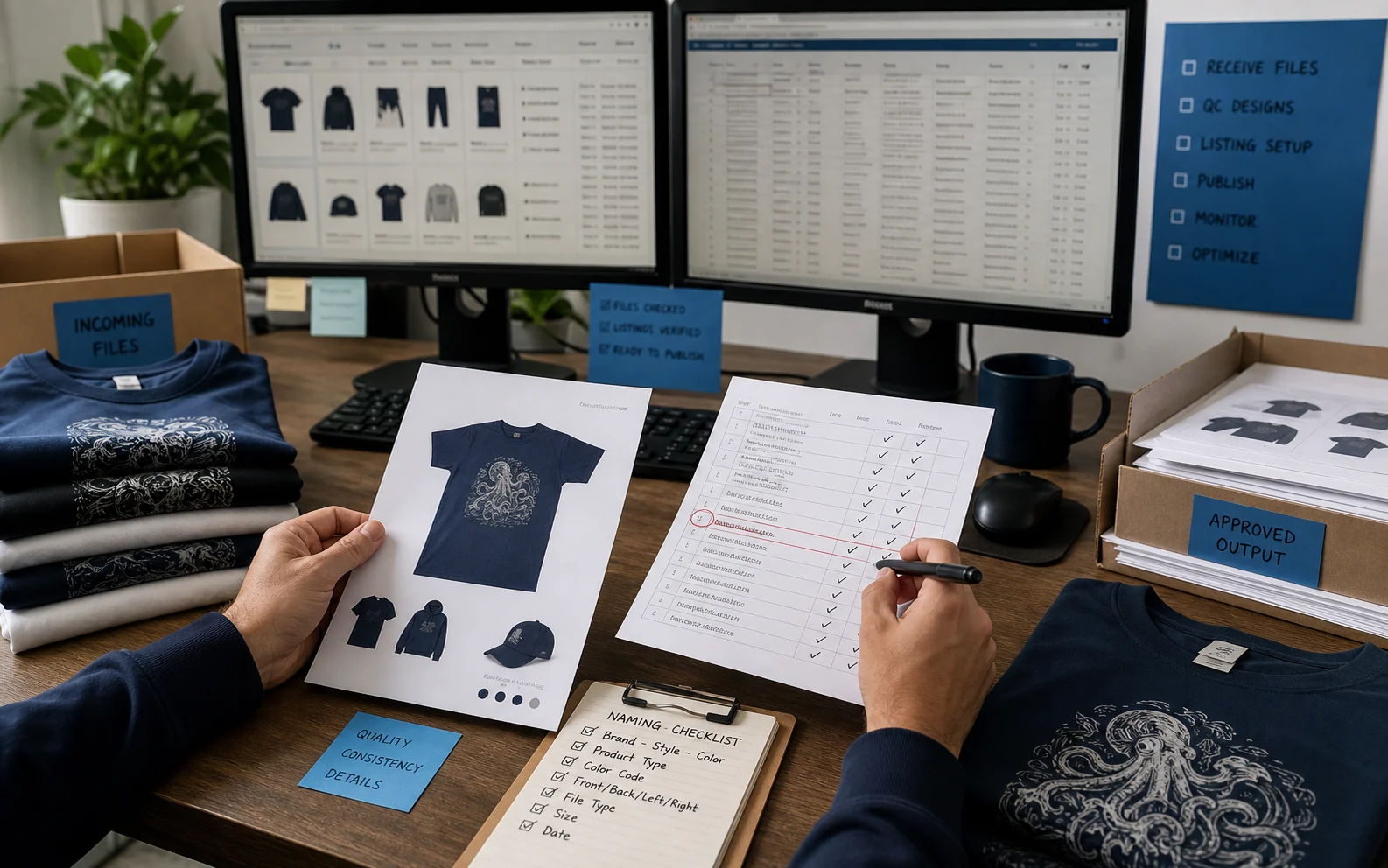
Outsourcing breaks down when each specialist completes a task but no one owns the transition. The fix is not more messages. It is a small source of truth that tells the researcher what decision to resolve, the designer what to make, the VA what is approved, and the owner where judgment remains.
Platform fields, permissions, and policy checks should be verified against the current official requirements for the exact account and marketplace.
The owner defines the decision before research begins
A researcher needs more than find a niche. Name the platform, product context, buyer, season or occasion if relevant, exclusions, and the decision the findings must support. The owner also states who can approve a direction and who handles unresolved rights or policy questions.
The research output should distinguish observations from inferences and end with a small set of actionable directions. It must not present demand, rank, sales, or legal clearance as guaranteed.
- Decision question.
- Buyer and occasion.
- Observable patterns and anti-codes.
- Rights and policy questions for owner review.
Research hands a brief to design—not a spreadsheet dump
The designer needs the approved buyer signal, required wording, visual direction, product, garment or background context, confirmed production specification, reference boundaries, and deadline for a real review. Raw keyword exports and screenshot folders do not make those decisions.
Keep the brief linked to the research record so a later change to the buyer or occasion is visible as a new decision, not disguised as a small revision.
- Approved direction.
- Product and placement.
- Production requirements.
- Named creative approver.
Design hands approved production files to operations
The VA should receive a clearly named final file, not a folder of concepts. The handoff identifies the product, placement, dimensions, background, approved wording, variant mapping, rights state, and any current policy question the owner still needs to resolve.
Include a small proof so the operator can compare what appears in the platform interface with what was approved. A file passing a mechanical check does not authorize the VA to settle a legal, policy, or product decision.
- Approved-final file.
- Listing and product mapping.
- Proof image.
- Open questions and escalation owner.
The listing queue records status and exceptions
Each record should show whether it is blocked, needs owner approval, is ready to publish, is published, was rejected, or has been retired. The operator records the returned status and evidence, then routes exceptions instead of editing the underlying decision silently.
Use the least-privilege access route available for the current platform. Passwords, backup codes, payment credentials, tax records, customer data, and private account exports do not belong in the queue or public intake.
- Current state.
- Platform-specific fields.
- Completion evidence.
- Exception and next owner.
A minimum handoff record
For each item, keep one stable identifier, source research, approved brief, approved artwork, production specification, product and variation choices, listing copy source, rights note, current status, decision owner, and dated change history.
This record does not guarantee platform approval or sales. It gives the team a shared view of what was decided, which inputs were used, and who owns the next step.
- Stable item ID.
- Approved inputs.
- Platform record.
- Status, owner, and change history.