
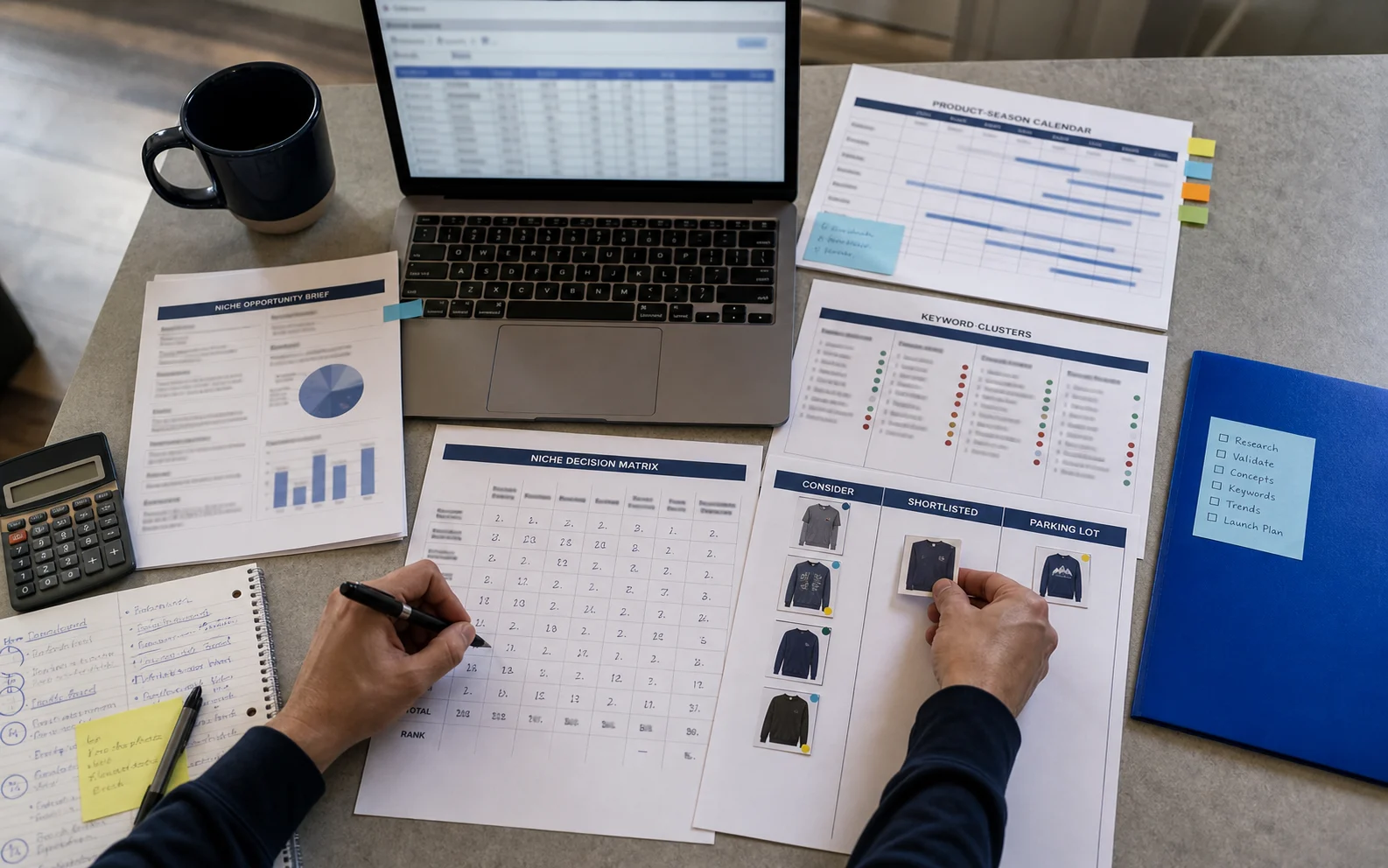
A useful Amazon Merch niche-research brief does not begin with “find winning niches.” It begins with a decision: which buyer, occasion, product context, or catalog gap should the team investigate, and what will the owner do differently after seeing the evidence? Define that question first, then record the marketplace, timing, exclusions, existing catalog, and decision owner.
Why a keyword dump is not a research brief
A list of phrases can show language worth investigating, but it does not explain who uses that language, why the product would be relevant, whether the idea fits the intended product, or what evidence is strong enough to justify a design brief. Search suggestions, visible listings, trend tools, ad data, and seller observations each describe different things. None of them alone proves future demand, sales, ranking, rights clearance, or platform approval.
The brief should therefore separate the question from the sources used to explore it. It should also name the limits: what could not be observed, what requires current account access, and what remains an owner decision.
The eight-field Amazon Merch research brief
| Decision field | Record this before research | If it is unknown |
|---|---|---|
| 1. Marketplace | Country, language, and the current account context. | Do not mix results from different markets as if they describe one audience. |
| 2. Product context | Product type, placement, available colors, and the production path being considered. | Mark the output as exploratory, not design-ready. |
| 3. Buyer | The person expected to recognize the identity, use, profession, hobby, relationship, or occasion. | Research buyer language before visual directions. |
| 4. Decision question | The choice the findings must support: explore, prioritize, differentiate, pause, or brief. | Stop. More data will not fix an undefined decision. |
| 5. Existing catalog | Related products, prior directions, duplicates, exclusions, and known performance context supplied by the owner. | State that catalog collision could not be checked. |
| 6. Evidence window | Dated sources, season or occasion window, observable signals, and known access limits. | Avoid presenting a timeless conclusion. |
| 7. Rights and policy boundary | Prohibited references, supplied marks, policy questions, and who verifies current rules. | Flag the direction; do not call it cleared. |
| 8. Handoff owner | Who approves a direction, briefs design, and owns unresolved platform decisions. | The output remains a research note, not an approved production brief. |
Separate observations, interpretations, and decisions
Use three labels in the final research record. An observation is something dated and visible in the named source. An interpretation explains what that signal might mean and includes uncertainty. A decision is the owner-approved action that follows. Keeping the labels separate prevents a visible pattern from quietly turning into a sales promise.
- Observation: record the source, market, date, query or browsing path, and what was visible.
- Interpretation: explain the possible buyer language, anti-codes, crowding, seasonality, or product fit.
- Decision: prioritize, narrow, test, brief, hold, or reject the direction—with an owner and review date.
Turn the research into a designable direction
The handoff to design should be short enough to use: one buyer, one primary message, one supporting context, relevant visual codes, prohibited directions, the intended product and colors, the production specification owner, and the evidence that led to the choice. A spreadsheet remains linked as supporting material; it should not become the creative brief by default.
If the buyer or message changes during design, record that as a new decision. If production requirements are unknown, route the work through the Print-on-Demand Design Guide before final artwork is prepared.
Know when research should stop
Stop and return the decision to the owner when the marketplace is unclear, rights or policy questions cannot be resolved, the existing catalog is unavailable, the evidence is too sparse for the requested conclusion, or the proposed direction does not fit a confirmed product. The responsible output may be a narrower question or a documented “do not proceed,” not a longer list.
What this brief can and cannot do
This framework can make research more traceable and useful to a designer, publisher, or account owner. It cannot guarantee demand, originality, legal clearance, platform acceptance, ranking, advertising performance, or sales. Always confirm current product templates, account fields, policies, and permissions inside the applicable official Amazon Merch on Demand resources and account context.
Primary source reviewed
Amazon’s official Merch on Demand overview explains the basic operating model—creators supply artwork and select product options while Amazon creates the product page and handles production-related operations. Product templates, royalties, account eligibility, and policies can change, so check the current official resources before acting: Amazon Merch on Demand overview.